AI Journaling vs Traditional Journaling: What Actually Changes (and What Doesn't)
Pen and paper or an AI that asks questions? What each does better, where AI journaling falls short, and how to choose - from the team building LifeStylo.
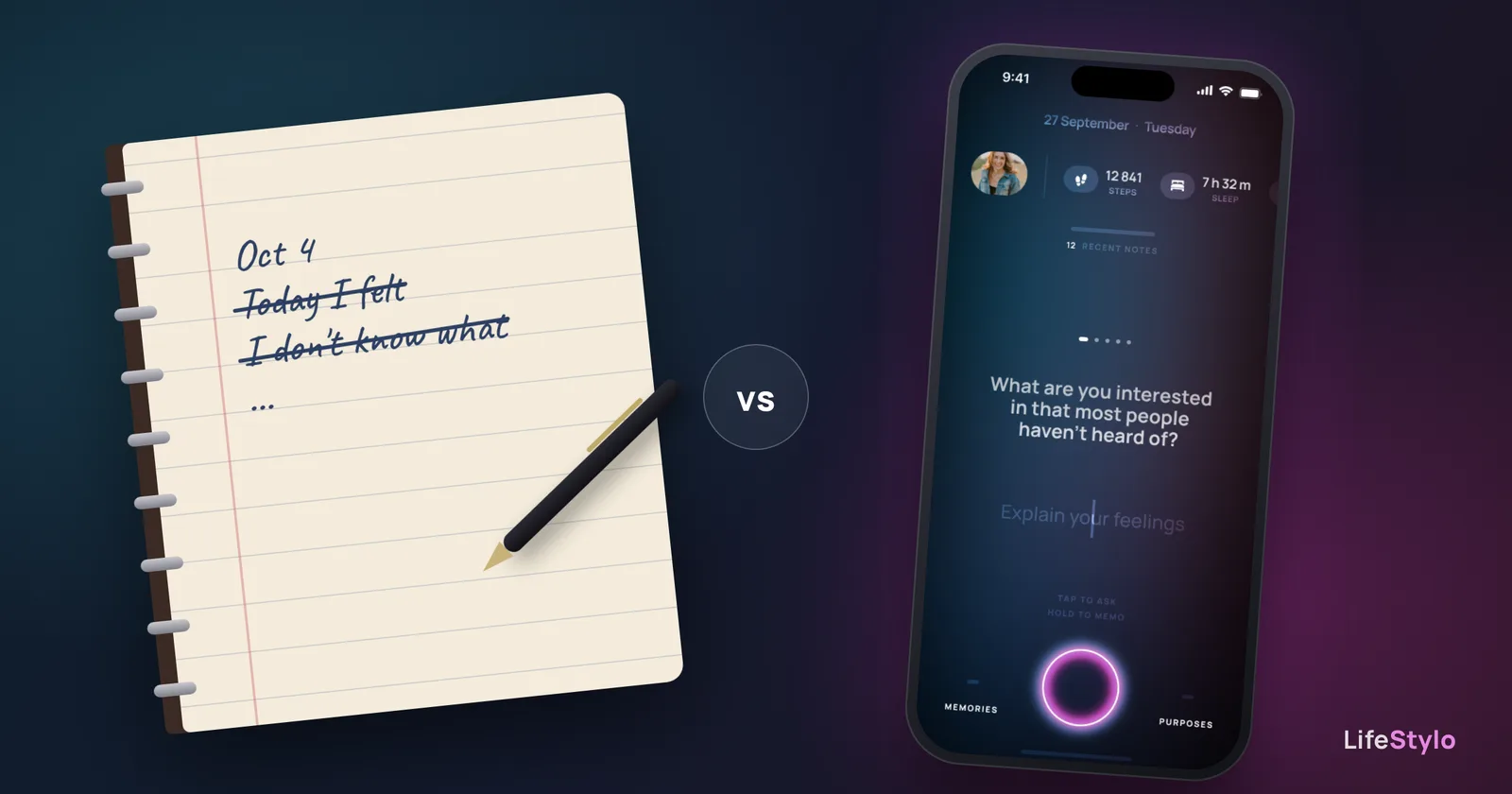
TL;DR
Traditional journaling is better for slow, private, unfiltered reflection. AI journaling is better for actually keeping the habit: it removes the blank page, lets you talk instead of write, and asks the follow-up question you would skip on your own. Neither is "the right way". Many people end up using both.
Traditional journal (paper or notes app) | AI journal | |
|---|---|---|
Getting started | Blank page; you decide what to write | The app opens with a question tailored to you |
Time per entry | 10–20 min to feel worth it | 30 seconds to a few minutes |
Input | Handwriting or typing | Conversation, voice, photos, video, quick mood check-ins |
Depth of reflection | As deep as you push yourself | Follow-up questions push you past the first answer |
Finding old entries | Flip pages or keyword search | Search by meaning ("when did I feel stuck at work?") |
Context beyond words | None | Can connect entries with sleep, activity and places you visited, if you allow it |
Privacy | Fully yours (a locked drawer) | Depends on the app: where data is stored, who processes it, whether you can delete it |
Who is in the room | Only you | You and a system that responds — helpful for some, intrusive for others |
Cost | A notebook | Free tier or subscription |
Why most people quit journaling
Most people quit journaling for the same reason: the blank page asks too much, too often. Wanting to understand yourself is not the hard part. Almost everyone does.
The pattern is familiar. You buy a nice notebook. You write three honest pages on day one. On day four you sit down, stare at the page and don't know what to say. You skip a day. Then a week. Then the notebook joins the others on the shelf.
That is a pity, because writing about your life does work. In James Pennebaker's early studies, students who wrote about difficult experiences for 15 minutes a day, four days in a row, visited the campus health center less often over the next six months than students who wrote about trivial topics (Harvard Health). The benefit comes from doing it. The habit is what breaks.
Meanwhile, most of life never makes it onto the page at all: a conversation that bothered you, a bad night's sleep, a place that made you feel calm, an idea you had on the walk home. By the time you sit down to write, most of it is gone.
AI journaling is mostly an attempt to fix this one problem: make capturing your life cheap enough that you keep doing it.
What "AI journaling" actually means
AI journaling means a journal that responds: instead of you filling a page, a system asks, listens and helps you go one step further. The term covers very different products, so it helps to separate three levels.
- Prompted journaling. The app shows a question ("What drained your energy today?") and you write the answer. The AI part is often just picking the prompt.
- Conversational journaling. You talk to an AI companion the way you would talk to a thoughtful friend. It asks follow-up questions based on what you just said, so the entry builds itself through dialogue.
- Multi-format life capture. Besides text, you add voice notes, photos, videos and quick mood check-ins. The system transcribes and understands them, so a 20-second voice memo counts as a real entry. With your permission, it can also use signals like sleep, activity or the places you visited to ask better questions.
What AI journaling is not: a diagnosis, therapy, or an algorithm that tells you who you are. A good AI journal helps you notice things. The conclusions stay yours.
Where traditional journaling still wins
We build an AI journal, and we still think paper is the better choice in several situations.
- Writing by hand engages your brain differently. A 2024 high-density EEG study found that handwriting produced widespread connectivity across brain regions linked to memory and learning, while typing did not (Van der Weel & Van der Meer, Frontiers in Psychology). If the act of writing is part of how you think, keep the pen.
- Slowness is sometimes the point. A conversation moves fast. A page lets you sit with one sentence for ten minutes. Some reflection only happens in silence.
- No one else is in the room. Even a well-designed AI responds, and a response shapes what you write next. For raw, unfiltered processing, an empty page can feel safer.
- Total privacy. A notebook in a drawer is never processed by a server. No app can fully match that, no matter how good its security is.
- No screen. Journaling at night on paper doesn't come with notifications or blue light.
If these matter most to you, a paper journal is not outdated. It's the right tool.
Where AI journaling helps
AI journaling helps most when your problem is consistency, not depth.
- No blank page. The conversation starts with a question about *your* day, not a generic prompt. Answering a question is far easier than starting from nothing.
- Follow-up questions. You write "work was stressful". A paper journal accepts that. A good AI companion asks what exactly happened, and that second answer is usually where the insight is.
- Talk instead of write. Record a voice note while walking. It gets transcribed and understood, so a busy day still produces an entry.
- Photos and videos count. A picture from dinner with a friend becomes part of the story, with its content recognized and searchable.
- Context you didn't type. If you connect Apple Health or allow location, the companion can notice a short night's sleep or ask about a place you visited today. You remember more because something asked.
- Search that understands meaning. Months later you can ask "when did I last feel really motivated?" instead of guessing which keyword you used.
The trade-off: you are no longer alone with the page. Some people find the questions helpful. Others find them distracting. Try both and notice which one you actually come back to.
Why not just use ChatGPT as a journal?
You can, and for occasional venting it works fine. The difference shows up when journaling becomes a habit.
- A general chatbot waits for you. It doesn't start the conversation, doesn't know you skipped three days, and doesn't ask about the trip you mentioned last week. A journal built for reflection starts the dialogue and adapts its questions to you.
- A chat is not a journal. Your entries end up scattered across dozens of chats mixed with work questions and recipes. A dedicated journal keeps your life in one place, with moods, voice notes and photos attached.
- Purpose-built analysis. In a dedicated app, each entry, mood check-in or conversation can be broken down and analyzed with methods designed for reflection, not just sent to a general model. At LifeStylo, for example, we don't route everything through one chatbot: we use different model families (GPT, Claude, Gemini, Mixtral and self-hosted models), each for the task it does best. Our analysis also relies on our own models trained on psychological data annotated by psychologists on our team, and our companion's prompts were refined with them. Its suggestions are explicitly non-medical.
- Your data has a clear purpose. In a general assistant, your journal sits next to everything else you use it for. In a journaling app, you can check exactly how your entries are stored and processed (see the checklist below).
If you already journal in ChatGPT and it works for you, keep going. If you keep forgetting to, that's the gap a dedicated AI journal fills.
Privacy checklist before you give an AI your journal
A journal is the most personal data you own, so check these five things before choosing any AI journaling app, ours included.
- Where is the data stored? Look for the country or region of the servers. If you're in the EU, EU hosting under GDPR is a meaningful baseline.
- Who processes your entries? Most AI journals send text to large language model providers. The privacy policy should name them and say whether your data is used to train their models.
- Can you delete everything? Not just your account, but every entry, voice note and photo.
- Is sharing opt-in? Health data, location and photos should only be used if you explicitly turn them on, and you should be able to turn them off.
- Does it claim to diagnose you? A journaling app that offers medical or psychiatric conclusions is overstepping. Reflection support is not treatment.
If an app can't answer these clearly, that's your answer.
Which one is right for you
Choose by the problem you actually have, not by which method sounds better.
If this sounds like you | Try |
|---|---|
You love writing and journal consistently already | Keep your paper journal |
You start journals and abandon them within a week | AI journal |
You think better out loud than on paper | AI journal with voice |
You want complete privacy, no servers involved | Paper journal |
Your days are busy and evenings are short | AI journal: 30-second entries |
You use journaling to process something heavy in silence | Paper journal (and a professional if it's very heavy) |
You want both depth and consistency | Both: quick AI check-ins daily, long-form writing on paper weekly |
The last option is more common than it sounds. The tools don't compete; they solve different parts of the same habit.
How we approach it at LifeStylo
We built LifeStylo because we kept seeing the same thing: people want to understand their lives, but almost nobody manages to keep a diary. Our answer is simple: less writing, more understanding.
Here is what the app does today:
- Oracle, a companion that starts the conversation. It opens with questions tailored to you and asks follow-ups as you talk.
- Any format. Text, voice notes (transcribed and understood), photos and videos (their content recognized), and quick mood check-ins.
- Context, only if you allow it. Apple Health data, and an approximate sense of where you've been so Oracle can ask about your day.
- Search that understands you. Find past moments by meaning, not exact words.
- The right model for each job. Different model families handle different tasks, alongside our own analysis models trained on psychologist-annotated data. Oracle offers reflections and suggestions, never diagnoses.
- Your data stays yours. You can export your journal or delete all of it at any time.
What we're still building: a long-term memory that connects your story across months and years. It's the core of where LifeStylo is going, and we'd rather ship it carefully than promise it early.
One principle holds throughout: an AI should help you notice things about your life, not decide who you are. The conclusions, and the data, stay yours.
Try LifeStylo free on the App Store — Android version coming soon.
Frequently asked questions
- Is AI journaling as effective as writing by hand?
- They work differently. Handwriting engages the brain more broadly and suits slow reflection. AI journaling makes it easier to journal consistently, which is where most people fail. The best method is the one you keep doing.
- Is it safe to write a journal with AI?
- It depends on the app. Check where data is stored, which AI providers process it, whether it's used for training, and whether you can delete everything.
- Can an AI journal replace therapy?
- No. An AI journal can support reflection and help you notice things, but it doesn't diagnose or treat. If you're struggling, talk to a professional.
- Can I use ChatGPT as a journal?
- Yes, for occasional reflection. A dedicated AI journal adds what a chatbot lacks: it starts the conversation, keeps entries in one place, and supports voice, photos and mood check-ins.
- How long should an AI journal entry be?
- A 30-second voice note is a valid entry. Consistency matters more than length.
- Can I use both paper and an AI journal?
- Yes. A common setup is quick daily AI check-ins plus longer handwritten reflection once a week.